
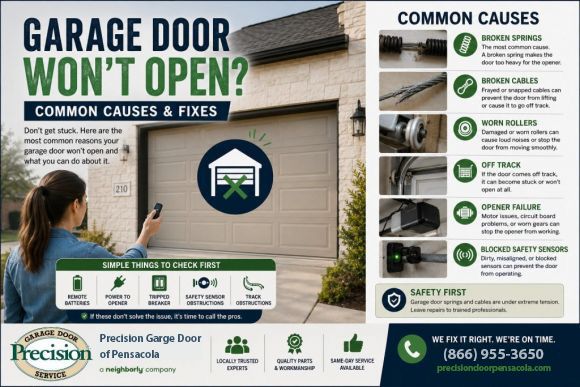
What Homeowners Should Know Before They’re Stuck
Few home problems are as frustrating as walking out to your garage, pressing the button, and realizing the garage door won’t open.
Whether you’re trying to leave for work, pick up the kids, escape the Texas heat, or simply get your vehicle out of the garage, a malfunctioning garage door can bring your day to a halt.
The good news is that most garage door problems are caused by a handful of common issues. Some are simple fixes homeowners can safely check themselves, while others require professional repair.
At Precision Garage Door, one of the most common service calls we receive is simply: “My garage door won’t open.”
Here’s what may be causing the problem and what you should do next.
First, Is the Door Completely Stuck or Partially Moving?
Before diagnosing the issue, pay attention to what happens when you try to operate the door.
Does the door:
- Do absolutely nothing?
- Make noise but not move?
- Move a few inches and stop?
- Start opening and then reverse?
- Open unevenly?
- Open manually but not with the opener?
The symptoms often point directly to the underlying issue.
Dead Remote Batteries
Sometimes the simplest answer is the correct one.
If the wall button works but the remote doesn’t, the batteries may simply need replacing.
Check:
- Remote batteries
- Keypad batteries
- Whether the remote is still programmed
If replacing the batteries doesn’t solve the issue, the remote itself may need reprogramming or replacement.
Power Issues
If neither the wall button nor the remote works, check whether the opener is receiving power.
Look for:
- An unplugged opener
- A tripped breaker
- A GFCI outlet that has tripped
- A power outage
Texas storms and power fluctuations can occasionally interrupt power to garage door systems.
If power is restored and the opener still doesn’t respond, additional troubleshooting may be required.
Broken Garage Door Springs
One of the most common reasons a garage door won’t open is a broken spring.
Garage door springs carry most of the door’s weight. When a spring breaks, the opener often cannot lift the door.
Signs of a broken spring:
- A loud bang from the garage
- The door feels extremely heavy
- The opener strains or hums
- The door only lifts a few inches
- A visible gap in the spring
Many homeowners describe the sound of a spring breaking as similar to a gunshot.
Important: Never attempt to repair a garage door spring yourself. Springs are under extreme tension and can cause serious injury.
Broken or Frayed Cables
Garage door cables work alongside the springs to safely lift and lower the door.
When cables become damaged, the door may:
- Become crooked
- Lift unevenly
- Jam during operation
- Refuse to open
Warning signs include:
- A loose cable hanging from the door
- The door leaning to one side
- Visible fraying or damage
Like springs, cable repairs should always be handled by trained professionals.
Worn or Damaged Rollers
Rollers help the garage door move smoothly along the tracks.
Over time, they can:
- Wear out
- Crack
- Seize up
- Fall off track
When this happens, the door may become difficult or impossible to open.
Common symptoms:
- Grinding noises
- Jerky movement
- The door binding during operation
- Increased vibration
Regular maintenance and annual tune-ups can often prevent roller-related failures.
Garage Door Off Track
If the tracks become bent, damaged, or misaligned, the door may become stuck.
Common causes include:
- Vehicle impact
- Broken hardware
- Worn rollers
- Loose brackets
Signs the door may be off track:
- Uneven gaps
- A crooked door appearance
- Metal scraping noises
- Rollers outside the track
Continuing to operate an off-track door can make the damage worse.
Garage Door Opener Failure
Sometimes the door itself is fine, but the opener has failed.
Common opener issues include:
- Motor failure
- Worn gears
- Circuit board problems
- Capacitor failure
- Travel limit issues
Signs of opener problems:
- The motor runs but the door doesn’t move
- Clicking sounds
- Flashing lights on the opener
- Intermittent operation
Modern Wi-Fi-enabled openers often provide additional diagnostics that can help identify the problem.
Safety Sensors May Be Blocked
Garage doors include photo-eye safety sensors near the floor.
If these sensors become:
- Dirty
- Misaligned
- Blocked
The system may prevent the door from operating properly.
Quick things to check:
- Remove debris
- Clean the sensor lenses
- Confirm the sensors face each other
- Check for blinking sensor lights
This is one of the easiest issues homeowners can safely inspect themselves.
Extreme Texas Heat Can Cause Problems
Summer temperatures can place additional stress on garage door systems.
Heat can contribute to:
- Expanded metal components
- Increased opener strain
- Worn lubricants
- Roller deterioration
- Electrical component failures
Many garage door failures occur during peak summer months when systems are working harder than usual.
Storm Damage and Moisture Issues
Heavy rain and storms can impact garage door operation.
Potential issues include:
- Water intrusion
- Electrical interruptions
- Sensor problems
- Rust or corrosion
- Power surge damage
If your garage door stops working immediately following a storm, it’s worth having the entire system inspected.
What Homeowners Can Safely Check
Before calling for service, you can safely:
- ✅ Replace remote batteries
- ✅ Verify power to the opener
- ✅ Check for tripped breakers
- ✅ Remove obstructions from the sensors
- ✅ Inspect for visible track obstructions
- ✅ Look for obvious damage
However, avoid attempting repairs involving:
- ❌ Springs
- ❌ Cables
- ❌ Tracks
- ❌ Opener disassembly
- ❌ Electrical components
These systems can be dangerous without proper training and tools.
Why Annual Garage Door Tune-Ups Matter
Many garage door failures are preventable.
An annual tune-up helps identify:
- Worn springs
- Failing rollers
- Loose hardware
- Opener issues
- Track alignment problems
- Safety concerns
Routine maintenance often catches problems before they leave homeowners stuck with a door that won’t open.
Why Homeowners Trust Precision Garage Door
At Precision Garage Door, we understand how disruptive garage door problems can be.
Our certified technicians arrive with fully stocked service vehicles and can complete most repairs during the initial visit.
We help homeowners with:
- Broken spring replacement
- Opener repair and replacement
- Cable repair
- Roller replacement
- Track repair
- Smart garage door upgrades
- Preventative maintenance
Our goal is simple: diagnose the problem quickly, repair it correctly, and get your garage door working safely again.
A garage door that won’t open is more than an inconvenience—it’s often a sign that an important component has failed or is nearing failure.
While some issues are simple, others can involve springs, cables, tracks, or electrical systems that require professional attention.
If your garage door suddenly stops working, don’t ignore the warning signs.
Addressing the issue early can help prevent additional damage, improve safety, and get your garage door back to operating smoothly.
Because when your garage door won’t open, you need a solution that’s fast, reliable, and done right the first time.