
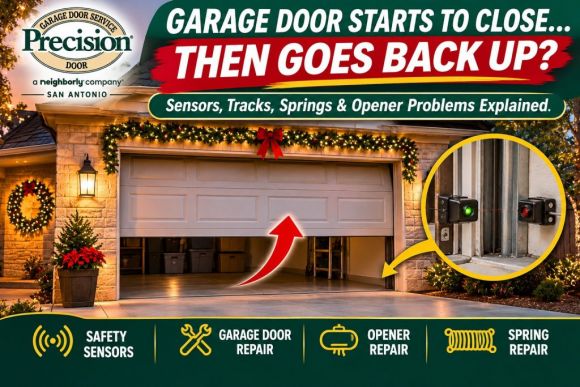
Why your garage door keeps reversing, what you can safely check yourself, and when to call Precision Garage Door of San Antonio for professional repairs.
You’re leaving for work, heading out to run errands, or getting ready to settle in for the evening. You press the garage door remote, watch the door start closing, and then something frustrating happens.
The garage door suddenly stops, reverses direction, and goes right back up.
You try again.
Same thing.
Maybe the door closes halfway before reversing. Maybe it gets within a few inches of the ground and opens again. Or perhaps it barely starts moving before the opener stops and the lights begin flashing.
For homeowners throughout San Antonio, this is a common garage door problem, and it can happen for several different reasons.
Sometimes the issue is relatively simple, such as an obstruction blocking the safety sensors. Other times, it may involve worn rollers, damaged tracks, incorrect opener settings, or mechanical problems that require professional attention.
Whatever the cause, a garage door that won’t stay closed is more than an inconvenience. It can leave your garage, vehicles, tools, and belongings exposed while creating concerns about your home’s security.
At Precision Garage Door of San Antonio, we help homeowners identify and repair garage door problems, including doors that reverse unexpectedly, malfunctioning openers, damaged components, and doors that won’t close properly.
Here’s what you should know when your garage door starts to close and then goes back up.
1. Your Garage Door Safety Sensors May Be Blocked
One of the most common reasons an automatic garage door reverses or refuses to close is a problem involving its safety sensors.
Most modern residential garage door openers use photoelectric safety sensors positioned near the bottom of the garage door opening.
These sensors create an invisible beam across the doorway.
If something interrupts that beam while the door is closing, the opener is designed to stop and reverse the door to reduce the risk of injury or damage.
Common objects that can block garage door sensors
- Children’s bicycles or scooters
- Toys and sporting equipment
- Storage boxes
- Trash cans
- Yard tools
- Leaves and debris
- Holiday decorations
- Objects extending into the garage door opening
Sometimes an object doesn’t need to be directly beneath the garage door to interfere with the sensors.
For example, a storage bin positioned near the side of the opening may partially block the sensor beam.
What you can safely check
Start by looking around the garage door opening.
Make sure there are no objects blocking the doorway or the area between the sensors.
Remove any visible obstructions while the door is stationary.
Then try closing the garage door again from a safe location where you can clearly see the entire opening.
If the door closes normally, an obstruction may have caused the problem.
However, if the door continues reversing, there may be another issue.
Precision Garage Door Tip: Never bypass, disconnect, or disable your garage door’s safety sensors to make the door close. These devices are important safety features.
2. Your Garage Door Safety Sensors May Be Misaligned
Even when nothing is blocking the doorway, the garage door sensors may not be communicating properly.
Photoelectric sensors generally need to be correctly positioned and aligned with each other.
If one sensor gets bumped or moves out of alignment, the opener may interpret the situation as an obstruction.
What causes sensor misalignment?
Common possibilities include:
- Accidentally bumping a sensor while cleaning
- Moving storage items near the doorway
- Contact from a bicycle or lawn equipment
- Loose sensor mounting brackets
- Vibration or movement over time
- Damage to a sensor or its mounting hardware
Signs your sensors may be misaligned
Depending on your garage door opener model, you may notice:
- The door starts closing and immediately reverses.
- The door refuses to close using the remote.
- The opener’s lights flash.
- A sensor indicator light is off or blinking.
- The wall control displays an error message.
Different opener manufacturers use different indicator lights and diagnostic codes, so consult your owner’s manual for the meaning of a particular signal.
What should you do?
Visually inspect the sensors to determine whether one appears damaged, loose, or pointed away from the other.
If the sensors have simply been bumped, some manufacturers provide procedures for checking alignment.
Follow the instructions for your specific opener.
If the sensors are damaged, the wiring appears compromised, or the problem continues, professional service may be needed.
Important: Do not modify the sensor wiring or attempt to defeat the safety system.
3. Dirty Sensor Lenses Could Be Interfering With the Safety Beam
Garage door sensors are typically located close to the floor, where dust and debris can accumulate.
In San Antonio, garages can collect dirt, pollen, dust, and other debris from regular vehicle traffic and outdoor conditions.
Over time, buildup on the sensor lenses may interfere with their operation.
How to check the sensor lenses
With the door stationary, visually inspect both sensor lenses.
If they appear dirty, gently clean them using a soft, dry cloth, following the manufacturer’s instructions.
Avoid abrasive materials, harsh chemicals, or excessive moisture.
After cleaning, test the door from a safe position.
If the problem continues, cleaning alone may not be enough.
What about sunlight?
In some installations, direct sunlight may interfere with certain photoelectric sensor systems.
If your garage door only has trouble closing during a particular time of day, sunlight exposure may be worth discussing with a technician.
However, intermittent reversal can also result from loose wiring, sensor problems, or mechanical issues, so the timing alone doesn’t establish the cause.
4. Your Garage Door Tracks May Be Damaged or Obstructed
Garage door tracks guide the rollers as the door opens and closes.
When the tracks are damaged, bent, obstructed, or misaligned, the door may encounter resistance during operation.
Depending on the opener and the severity of the problem, the door may stop or reverse.
Warning signs of track problems
- The door moves unevenly.
- One side appears higher than the other.
- The door shakes or jerks while moving.
- You hear scraping or grinding sounds.
- The door becomes stuck at a particular point.
- Rollers appear to be moving improperly.
- The tracks have visible bends or damage.
Can you check the tracks yourself?
You can visually inspect the tracks from a safe distance while the door is stationary.
Look for obvious debris, damage, or misalignment.
However, do not loosen track brackets, remove rollers, or attempt to force a damaged door into position.
Garage door tracks and related hardware work together with a heavy, tensioned system.
Improper adjustments can create serious safety hazards.
When to call Precision Garage Door: If your garage door is crooked, scraping, binding, or visibly off track, stop operating it and schedule professional inspection.
5. Worn or Damaged Rollers May Be Preventing Smooth Operation
Garage door rollers help the door travel along its tracks.
Over time, rollers can wear, crack, seize, or develop other problems.
Damaged rollers may cause excessive friction or uneven movement.
Signs your garage door rollers may need attention
- Grinding or squeaking noises
- Jerky movement
- Visible roller damage
- Increased vibration
- Uneven door travel
- Rollers that appear to bind or stop turning
When a garage door encounters unusual resistance, some openers may stop or reverse as part of their obstruction-detection function.
However, not every reversal is caused by rollers.
A professional inspection can help determine whether the rollers are contributing to the problem.
Why replacing one part isn’t always the complete solution
Garage doors operate as interconnected systems.
If rollers are worn, other components may also need evaluation.
For example, damaged tracks, worn hinges, or balance problems may affect how smoothly the door moves.
Precision Garage Door of San Antonio can evaluate the door’s mechanical components and recommend appropriate repairs.
6. Your Garage Door Opener’s Travel Settings May Be Incorrect
Garage door openers use travel settings to determine how far the door should move when opening and closing.
If the closing travel is incorrectly configured, the opener may attempt to move the door beyond its proper closed position.
This can cause the opener to interpret contact with the floor as an obstruction and reverse the door.
Signs of a travel-setting problem
You may notice that:
- The door closes almost completely before reversing.
- The door touches the floor and then goes back up.
- The problem began after opener installation or adjustment.
- The door repeatedly reverses at approximately the same point.
Can you adjust the travel settings yourself?
Some opener manufacturers provide user adjustment procedures.
However, travel adjustments should only be made according to the manufacturer’s instructions, and the required safety reversal tests must be completed afterward.
Incorrect settings can create unsafe operating conditions.
If you’re uncertain about the adjustment process or the door continues reversing, contact a professional.
Precision Garage Door Tip: If your garage door reaches the ground and immediately reverses, the problem may involve travel settings, obstruction detection, or mechanical resistance. Proper diagnosis matters.
7. The Opener’s Force Settings or Obstruction Detection May Be Causing Reversal
Automatic garage door openers are designed to respond when they encounter unexpected resistance.
This helps reduce the risk of the door continuing to close against an obstruction.
Depending on the opener, this function may involve force settings, electronic monitoring, or other obstruction-detection technology.
Why the door may reverse unexpectedly
Potential causes include:
- Excessive resistance from worn components
- Improper opener configuration
- A door that is difficult to move
- Track or roller problems
- Incorrect travel settings
- An opener malfunction
Why you shouldn’t simply increase the closing force
If a garage door keeps reversing, increasing the force setting may seem like an easy solution.
But that can be dangerous.
The opener may be responding to a genuine mechanical problem or obstruction.
Increasing closing force without identifying the cause can interfere with safe operation.
A qualified technician should determine whether the issue involves the opener’s settings, the garage door itself, or another component.
8. Your Garage Door Springs May Be Worn or Damaged
Garage door springs help counterbalance the door’s weight.
Without properly functioning springs, the opener may struggle to move the door safely and consistently.
Although spring problems are often associated with garage doors that won’t open, they can also contribute to abnormal movement and operating problems.
Signs of a possible spring problem
- The door appears crooked.
- The opener struggles during operation.
- The door moves unevenly.
- You hear an unusual loud bang.
- A torsion spring has a visible gap.
- The door seems unusually heavy.
- The door stops or behaves unpredictably.
Garage door spring safety
Garage door springs operate under significant tension.
Never attempt to adjust, remove, or replace springs yourself unless you are properly trained and equipped.
Likewise, do not disconnect the opener and attempt to manually lift a door when you suspect a broken spring or cable problem.
A heavy or unbalanced door can fall unexpectedly.
If you suspect spring damage, stop using the door and contact a qualified garage door technician.
Precision Garage Door of San Antonio provides professional garage door spring repair and replacement services to help restore proper operation.
9. Damaged Cables or Other Mechanical Components May Be Affecting the Door
Garage doors rely on several mechanical components to move safely.
These may include:
- Lift cables
- Drums
- Hinges
- Brackets
- Rollers
- Tracks
- Springs
- Counterbalance hardware
If one of these components is damaged or malfunctioning, the door may become uneven, bind, or fail to operate correctly.
Warning signs that require professional attention
- Frayed or loose cables
- A crooked door
- A roller outside its track
- Visible structural damage
- A door that appears to be hanging unevenly
- Sudden loud noises followed by abnormal movement
These conditions can create serious safety risks.
Do not continue operating a garage door that appears crooked, has a damaged cable, or is partially off track.
The safest next step is professional inspection.
10. Your Garage Door Opener May Be Malfunctioning
Sometimes the garage door itself is in good condition, but the opener isn’t functioning properly.
Modern garage door openers contain motors, circuit boards, sensors, control systems, and other components.
Problems involving these systems may cause inconsistent operation.
Potential opener-related issues
- Faulty electronic controls
- Damaged sensor wiring
- Malfunctioning safety sensors
- Incorrect travel settings
- Obstruction-detection problems
- Worn internal components
- Intermittent electrical problems
Signs your opener may need repair or replacement
- The door reverses unpredictably.
- The opener stops at inconsistent points.
- The motor runs but the door doesn’t move properly.
- The opener displays recurring error codes.
- The opener makes unusual noises.
- The system frequently fails to respond to controls.
Should you repair or replace the opener?
That depends on several factors.
Repair may make sense when the opener is relatively new, compatible replacement parts are available, and the problem is limited to a repairable component.
Replacement may be worth considering when the opener is older, has recurring problems, lacks required safety features, or the cost of repair is substantial relative to a new unit.
Newer openers may also offer features such as Wi-Fi connectivity, battery backup on select models, and quieter operation.
A technician can help determine which option is appropriate.
Why Does My Garage Door Reverse at Different Points?
The point where your garage door reverses can provide useful clues about the problem.
However, the location of the reversal doesn’t always identify the exact cause.
| What your garage door does | Possible causes |
|---|---|
| Starts closing, then immediately reverses | Safety sensors, sensor wiring, obstruction, or opener problem |
| Closes halfway, then reverses | Track damage, rollers, mechanical resistance, or opener obstruction detection |
| Gets within a few inches of the floor, then reverses | Obstruction, track or seal interference, travel settings, or opener issue |
| Touches the floor, then opens again | Closing travel settings, mechanical resistance, or opener configuration |
| Reverses at different points each time | Intermittent sensor issues, wiring problems, mechanical resistance, or opener malfunction |
| Won’t close using the remote | Sensor problem, opener controls, or another safety-system fault |
| Moves crookedly and reverses | Possible spring, cable, track, or roller problem |
Important: These are possible explanations, not definitive diagnoses. A professional inspection may be necessary to identify the actual cause.
What Can You Safely Check Before Calling a Garage Door Technician?
If your garage door begins closing and then reverses, there are a few basic checks homeowners can perform without disassembling the system.
A simple troubleshooting checklist
1. Check for visible obstructions.
Make sure the doorway and sensor area are clear of boxes, tools, toys, and other objects.
2. Look at the safety sensors.
Check for visible damage, obvious misalignment, or dirty lenses.
3. Clean accessible sensor lenses.
Use a soft, dry cloth and follow the manufacturer’s instructions.
4. Check the opener’s indicator lights or display.
Consult the owner’s manual for the meaning of flashing lights or error codes.
5. Observe the door’s movement.
From a safe location, note whether the door reverses immediately, halfway down, or after touching the floor.
6. Listen for unusual sounds.
Grinding, scraping, popping, or loud banging may indicate mechanical problems.
7. Look for visible damage.
Check for bent tracks, damaged rollers, frayed cables, or a crooked door without touching the components.
8. Stop if the door appears unsafe.
Do not continue testing a door that binds, hangs unevenly, or shows signs of spring or cable damage.
What homeowners should never do
Avoid the following:
- Disconnecting or bypassing safety sensors
- Forcing the door closed
- Increasing closing force to overcome resistance
- Adjusting springs or cables
- Removing loaded brackets
- Attempting to straighten damaged tracks while the door is under load
- Standing beneath a malfunctioning garage door
- Allowing children or pets near the door during troubleshooting
If the cause isn’t obvious or the door continues malfunctioning, schedule professional service.
Why a Garage Door That Won’t Close Is a Security Concern
A garage door that won’t stay closed can create more than a scheduling inconvenience.
For many San Antonio homeowners, the garage is one of the largest entry points into the home.
It may contain:
- Vehicles
- Tools
- Bicycles
- Lawn equipment
- Holiday decorations
- Stored belongings
- Access to the home’s interior
If the garage door remains open unexpectedly, these areas may become more accessible.
This is particularly concerning during the holiday season, when homeowners may be traveling, shopping, or hosting guests.
What should you do if your garage door won’t close?
If the door cannot be closed safely, avoid forcing it.
Keep the garage-to-house entry door locked, secure valuables when it is safe to do so, and arrange for professional repair.
Do not attempt to defeat the opener’s safety features to close the door.
Why November Is a Smart Time to Address Garage Door Problems in San Antonio
As Thanksgiving approaches, many San Antonio homeowners are preparing for holiday gatherings and travel.
That often means more vehicles coming and going, more packages being delivered, and more activity around the garage.
A garage door that reverses unexpectedly can disrupt those plans.
Before holiday guests arrive
Make sure your garage door opens and closes reliably.
Before Thanksgiving travel
Confirm that your garage door closes completely and that the opener operates correctly.
Before the Christmas shopping season
Address problems that could leave the garage unexpectedly open.
Before cooler weather arrives
Have worn or damaged components evaluated rather than waiting for a more serious malfunction.
Before a small issue becomes a larger repair
Some garage door problems begin with relatively minor symptoms.
Identifying the cause early may help prevent additional wear or unexpected failures, although not every problem can be predicted or prevented.
A garage door that repeatedly reverses is telling you something isn’t working correctly. Don’t ignore it.
Repair or Replace? What If Your Garage Door Keeps Having Problems?
Sometimes an unexpected reversal can be resolved by correcting a sensor problem or repairing a specific component.
But what if your garage door has been experiencing recurring issues?
What if you’ve already replaced parts, scheduled multiple service calls, and continue having problems?
At some point, it’s worth evaluating whether continued repairs are the best long-term investment.
When garage door repair may make sense
Repair may be appropriate when:
- The door is structurally sound.
- The issue is isolated to a repairable component.
- The system is otherwise operating properly.
- Replacement parts are available.
- The repair cost is reasonable.
- The door has no significant history of recurring problems.
When replacement may deserve consideration
A new garage door may be worth evaluating when:
- The existing door has extensive damage.
- Multiple major components are deteriorating.
- The door has recurring mechanical problems.
- The door is severely corroded or misaligned.
- Significant repairs are becoming frequent.
- You want improved insulation or a different appearance.
- The existing door no longer meets your needs.
Don’t confuse a door problem with an opener problem
A malfunctioning opener doesn’t automatically mean you need a new garage door.
Likewise, installing a new opener won’t correct a damaged door, broken spring, or serious track problem.
The most cost-effective solution starts with identifying the actual cause.
At Precision Garage Door of San Antonio, our technicians can evaluate the system and explain whether repair, opener replacement, or a new garage door is appropriate.
How Precision Garage Door of San Antonio Can Help
If your garage door starts to close and then goes back up, you shouldn’t have to keep guessing what’s wrong.
Precision Garage Door of San Antonio provides professional garage door troubleshooting and repair services for homeowners throughout the San Antonio area.
Our services include:
- Garage door repair
- Garage door opener repair
- Garage door opener replacement
- Broken spring repair and replacement
- Roller replacement
- Cable and hardware repair
- Track-related repairs
- Garage door maintenance
- Multi-point safety inspections
- New garage door installation and replacement
Our technicians can evaluate the condition of your garage door, identify potential causes of abnormal operation, and explain recommended repairs.
With service vehicles stocked for many common repairs, numerous issues can be addressed during the initial visit, depending on the required parts and scope of work.
Whether the problem involves a malfunctioning sensor, worn mechanical components, or an aging opener, professional diagnosis can help you avoid unnecessary repairs and restore reliable operation.
Don’t Let a Garage Door That Won’t Close Disrupt Your Holiday Plans
A garage door that starts closing and then reverses may seem like a minor inconvenience.
But when it happens repeatedly, it can interfere with your daily routine, create security concerns, and potentially indicate a more serious mechanical or electrical problem.
The cause could be something as simple as an obstructed safety sensor.
Or it could involve damaged tracks, worn rollers, spring problems, incorrect opener settings, or malfunctioning equipment.
The important thing is to identify the cause rather than repeatedly forcing the door to operate.
If your garage door won’t stay closed, contact Precision Garage Door of San Antonio for professional troubleshooting and repair.
Visit Precision Garage Door of San Antonio to learn more or schedule service.
Because when you tell your garage door to close, it should stay closed.
Frequently Asked Questions
Why does my garage door start closing and then immediately open?
Possible causes include blocked or misaligned safety sensors, damaged sensor wiring, an obstruction, or an opener-related problem. The exact cause depends on the door’s behavior and equipment.
Why does my garage door go all the way down and then back up?
If the door reaches the floor before reversing, incorrect travel settings or an obstruction-detection issue may be involved. Mechanical resistance can also contribute. Professional diagnosis may be needed.
Why does my garage door close halfway and reverse?
A door that reverses halfway may be encountering resistance from worn rollers, damaged tracks, or other mechanical problems. Opener settings or obstruction-detection issues may also contribute.
Why are my garage door opener lights blinking?
Flashing opener lights may indicate a safety sensor problem, obstruction, or another diagnostic condition. The meaning varies by manufacturer and model. Consult the opener manual for the specific signal.
Can I close my garage door if the safety sensors aren’t working?
Do not bypass or disable safety sensors. If the system isn’t functioning correctly, follow the manufacturer’s safety guidance and contact a qualified technician.
Can cold weather cause my garage door to reverse?
Temperature changes can affect certain materials and may expose existing mechanical problems, but cold weather alone doesn’t establish the cause. Sensors, opener settings, and mechanical components should be evaluated.
Do I need a new garage door opener if the door keeps reversing?
Not necessarily. The problem may involve sensors, door hardware, springs, tracks, or other components. A technician can determine whether the opener needs repair or replacement.
Is it safe to keep using a garage door that reverses unexpectedly?
Repeated unexpected reversal indicates a problem that should be investigated. If the door is crooked, damaged, binding, or showing signs of spring or cable failure, stop operating it and seek professional service.